
Is prostate brachytherapy right for you?
Deciding whether prostate brachytherapy is right for you
We know that there is a lot to take in and we want you to fully understand what is involved and why, so do not be afraid to ask questions. We do not mind repeating what we have said if you did not understand it the first time. If you want to, you can bring someone with you or write notes, as this may help you remember what has been said.
The right treatment for you will depend on the stage of your cancer, your age, possible side effects of the treatment, whether your disease might potentially develop over time, and of course, your own personal preferences.
If you have localised prostate cancer (your cancer is contained within the prostate gland) and you are a suitable candidate for brachytherapy, it will still be your decision whether you want to have brachytherapy or not.

If brachytherapy is not the right treatment for you, there are other treatment options that have good results too.
We like to treat patients as individuals and not just treat their cancer. Our team is happy to discuss all aspects of your treatment options with you.
If you want to find out who you may need to see, click here to Meet our team or Contact us. We look forward to talking to you.
If you want to find out more about the available treatments, click here to use the Treatment selector.
Important facts
- You are in reasonably good health
- You have few bothersome urinary symptoms
- Your cancer is confined to the prostate gland
- Occasionally, if our assessment suggests that there is a high chance prostate cancer cells may have spread to cells outside your prostate gland you may be offered a short course of external beam radiotherapy (EBRT) and hormone therapy before you have brachytherapy. Such patients typically have a PSA above 20ng/ml, Gleason scores of 8, 9 or 10 or evident of local spread just outside the gland, Stage 3a.
Click here to find out about EBRT
- We may also suggest that you have a 3-month course of Hormone Therapy before the EBRT, as research studies have shown this can increase your chances of a success.
- The size of your prostate gland is less than 60cc measured by transrectal ultrasound or less than 80cc on MRI. For successful treatment with brachytherapy the prostate gland should be relatively small – ideally less than 60cc. If the gland is too large, areas of the prostate may be shielded by the bony skeleton making it difficult to implant the seeds in the right place.
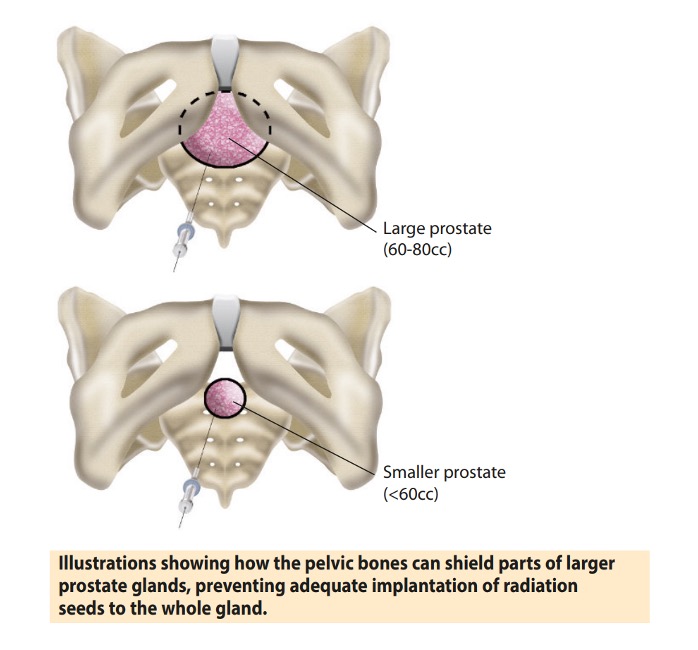
- If at your assessment visit we found by ultrasound examination that your prostate gland is larger (60-80cc) than the ideal size for successful brachytherapy treatment you may need a 3-month course of hormone therapy. This will shrink your prostate down to an acceptable size so that you can proceed to treatment.
If you need to have hormone therapy before brachytherapy, we will discuss the benefits and side effects with you before starting the treatment. - You have not had previous urinary surgery or previous pelvic radiotherapy (EBRT) that may prevent us treating you with brachytherapy.
- You do not have severe urinary symptoms, such as a very weak stream or difficulty emptying your bladder.
- Occasionally, if patients have a slow stream but a relatively small prostate gland, a small operation can be performed 2/3 months before the implant to unblock the urinary stream – this operation is called a ‘limited’ TURP.
- For more information about this procedure, please see the downloadable booklet or talk to your specialist to discuss if this treatment is suitable for you.
- You are able to flex your hips to 90 degrees.
At your assessment visit
- We will ask you questions about any previous illnesses, operations or medications so that we have your full medical history.
- We will ask you to complete a short questionnaire about your symptoms.
Click here to see the Male Health Inventory questionnaire you will be given. - You will need to have a comfortably full bladder when you arrive at the Centre as we will measure your urine flow rate when you are urinating.
- We will then scan your bladder to see if there is any urine left in it.
- You will have a digital rectal examination to assess the stage of your cancer
Click here to find out about the stages of prostate cancer
- We will also want to know about the grade of or the Gleason score of your prostate cancer.
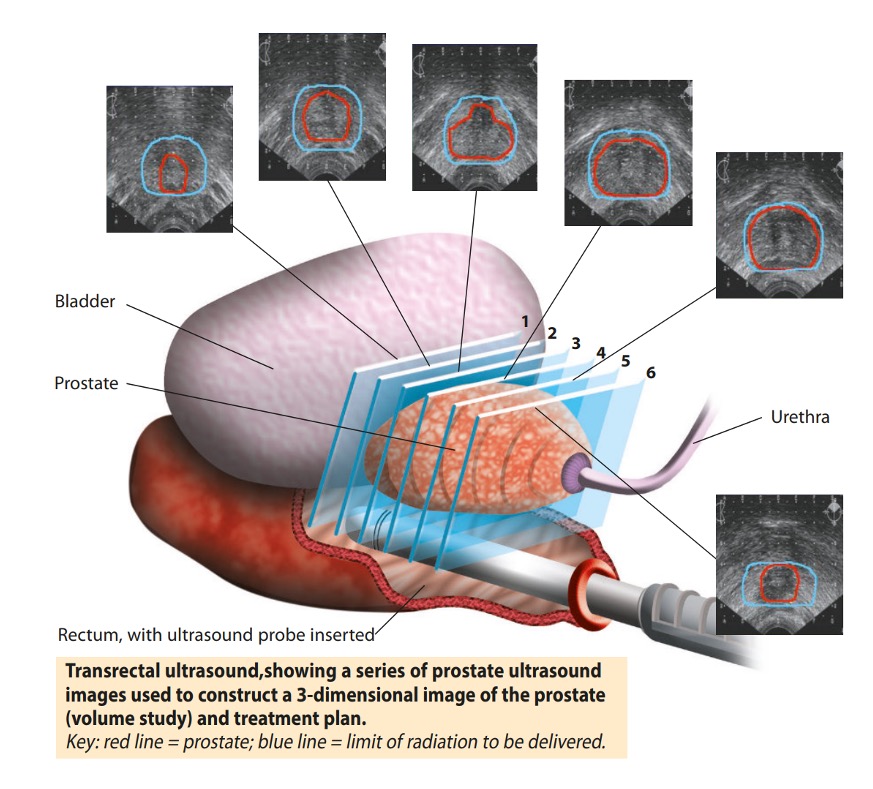
- You will have an ultrasound scan, called a transrectal ultrasound or TRUS, to assess the size and shape of your prostate gland. The pictures of your prostate we take help us decide whether brachytherapy is right for you. The pictures also help us plan where we will implant the seeds should you go on to have prostate brachytherapy treatment.
Brachytherapy is not the only treatment for prostate cancer, but it is as effective for suitable patients at treating the cancer as surgery (radical prostatectomy) or external beam radiotherapy. It also has a very low risk of incontinence or over 80% of men retain erectile function. It is important, however, that you weigh up all your treatment options before making your decision.
Receiving treatment
At The Prostate Brachytherapy Centre we carry out the most advanced and up-to-date brachytherapy procedure, namely a one-stage, real-time technique 4D Brachytherapy. This technique developed by Professor Langley and Dr Laing uses a combination of stranded seeds around the periphery of the prostate and lose seeds within the centre of the gland. The technique has been shown to maximise the radiation dose to the prostate whilst minimising the risk of erectile dysfunction and urinary problems. The procedure is usually performed as a day case.
After your assessment visit, and if brachytherapy is right for you, our Brachytherapy Co-ordinator will suggest some possible dates for you to come to the Centre to have the procedure.
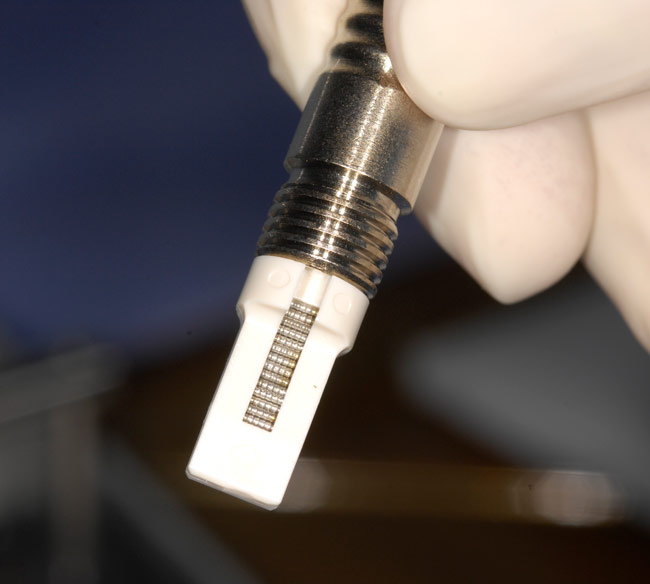
The seeds we will implant into your prostate gland are prepared specifically for you in the USA. We usually like to leave at least 3 weeks after your assessment visit before the date we ask you to return for brachytherapy treatment. This gives us time to work out the number of seeds we need to order and for them to be delivered on the right date.
If you need to come to have EBRT you will need to come to the Centre daily, 5 days a week, for either 21/2 or 5 weeks depending on the severity of the cancer. If you do not live close to our Centre we can arrange for your local cancer centre to give you the course of EBRT, if this is more convenient for you. We will discuss with you the benefits and side effects of any hormone therapy or EBRT that we recommend before you make your final decision.
If you have hormone therapy, the prostate size should shrink and therefore you will also need to have another ultrasound scan (TRUS) to re-assess the size and shape of your prostate gland. These pictures will then be used to plan where we will place the radioactive seeds for the implant.
It is by tailoring your treatment options according to your needs that we can make sure we give you your best chance of successful treatment.
The procedure
The prostate brachytherapy procedure
The prostate brachytherapy procedure is when the radioactive seeds are implanted into your prostate gland under a general anaesthetic, in our operating theatre.
Your appointment for your prostate brachytherapy procedure is normally about 3 weeks after your planning ultrasound scan.
You will be usually admitted to hospital for just the day and the procedure typically takes about 40 minutes. During the procedure a 3-Dimensional computerised model of the prostate is created allowing detailed planning of where to implant the seeds. Areas known to contain cancer are maximally treated in a technique termed dose painting.
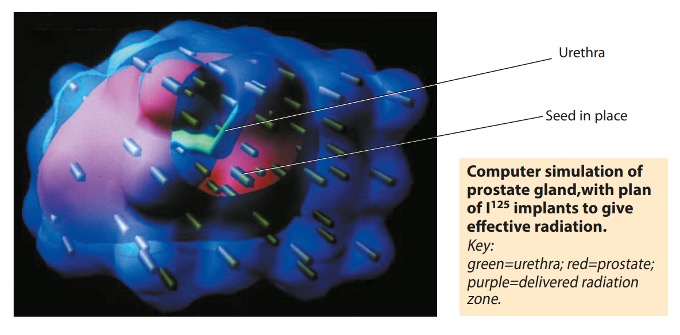
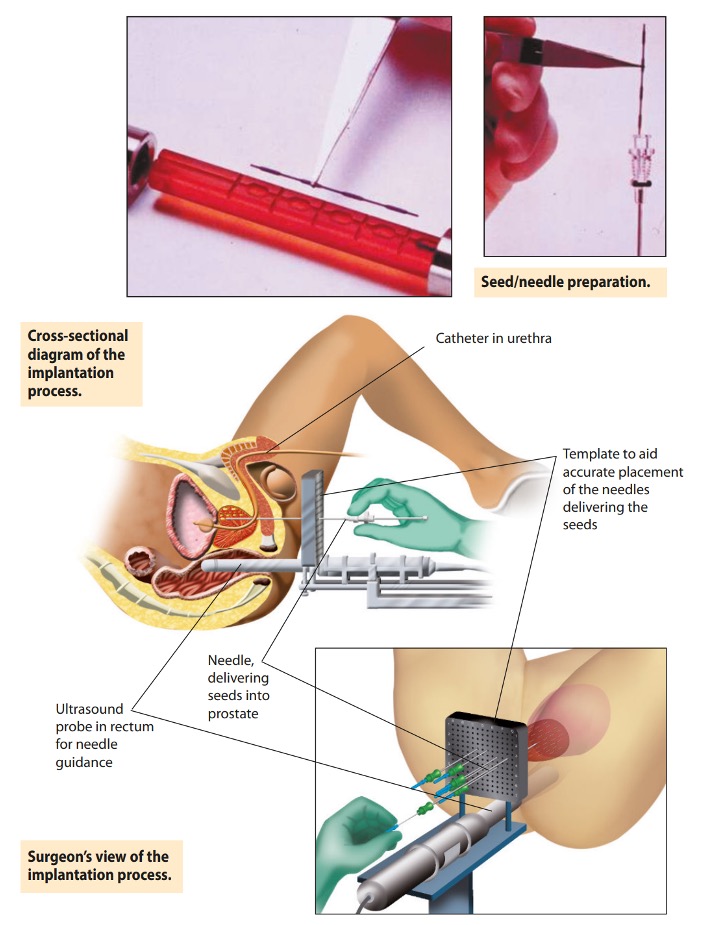
The stranded seeds are initially implanted with fine needle passing though the perineum under ultrasound guidance. Then the loose seed are inserted in the centre of the gland optimizing the radiation dose. The computerised planning system provides continual feedback of the radiation doses being delivered. The procedure is performed by a team of clinicians including an urologist, an oncologist and two medical physicists to ensure the precise radiation dose is delivered to the target organ.
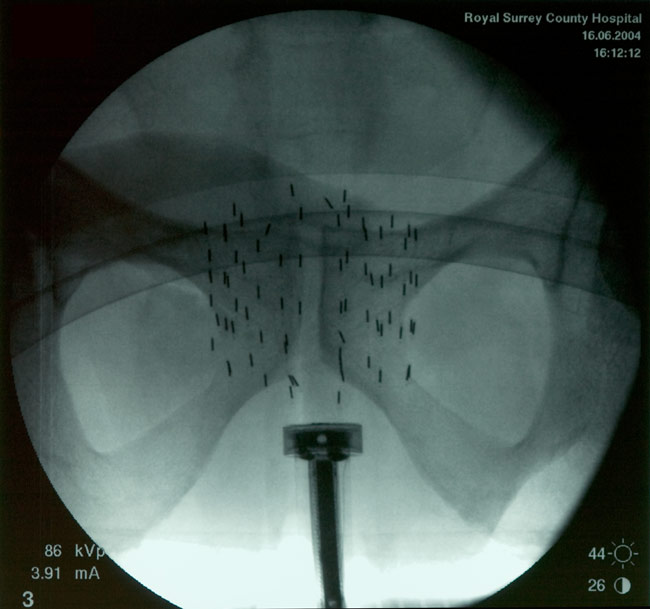
Afterwards you will spend about 30mins in the recovery room recovering from the effects of the anaesthetic. A CT scan is then performed to verify the position of the radioactive seeds and ensure the optimal radiation dose has been delivered.
The day before the seeds are implanted
You will be sent a sachet of a powdered bowel preparation called Picolax. After mixing the contents of the sachet with water, drink the bowel preparation on the day before you come to the Centre for the prostate brachytherapy procedure. It is important that you drink plenty of water both the day before and for at least 48 hours after the procedure to make sure you keep yourself hydrated.
On the day you have the seeds implanted
The ultrasound probe is removed before you wake up and the catheter is removed once the effects of the anaesthetic have worn off and you have had a CT scan to confirm the position of the seeds.Under a general anaesthetic the ultrasound probe allows us to see a picture of your prostate gland.
Our planning computer will construct a three-dimensional (3-D) picture of your prostate gland so that we can calculate where we need to implant the seeds. We will insert between 20 and 30 fine hollow needles into your prostate gland through the perineum (the skin between the scrotum and the anus). The ultrasound pictures help to guide the needles to the exact planned position.
We will insert between 2 and 6 seeds through each of the needles and implant between 60 and 120 seeds in total into your prostate gland. We will implant some of the seeds around the edge of your prostate gland. These seeds are woven into a strand of absorbable material that helps keep the seeds in place.
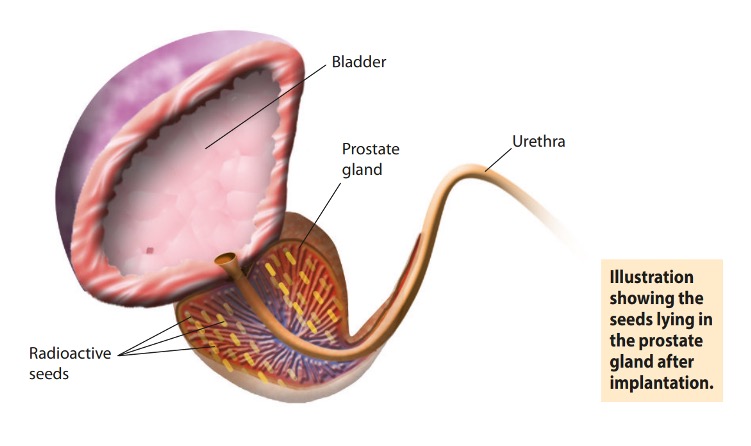
Once all the seeds have been inserted via the needles and are in the right place The needles are removed and the seeds remain permanently in place. You will have a CT scan to confirm the position of the seeds.
After the seeds are implanted
While in hospital, your urine will be filtered, to ensure that any loose seeds that you may pass are caught. This event is rare and usually will happen within the first 24 hours following implant.
We will ensure that you are able to pass urine satisfactorily before you are discharged home. A small percentage of patients (approximately 2%) may hold a significant residual amount of urine in their bladder immediately after the implant. This may result patients being taught how to pass a fine catheter themselves for a period of time. This is normally only for a week or less, until normal voiding returns. It is quite common to see some blood in the urine for a while after the procedure. This is quite normal, so do not be alarmed.
For one week after the implant, you must drink plenty of water to flush through any small blood clots that may occur in the urine. Thereafter, you should return to a normal drinking pattern and your daily intake should not normally exceed 1.5 litres per day (about 2½ pints). It is important that you avoid all caffeinated drinks (tea, coffee, coke) in the first few months after the implant, as these are likely to aggravate your urinary symptoms.


Take any medicines we give you
After your brachytherapy treatment we will give you some medicines to take: These are an alpha-blocker, such as tamsulosin (Flomax®) or alfuzosin (Xatral®). This medicine relaxes the muscle within the prostate gland and helps to reduce the narrowing of the urethra (water pipe) as it runs through the swollen prostate, so reducing urinary symptoms. This is best taken in the early evening. You will be encouraged to take this medicine for at least 3-6 months after the implant. Your GP will give you a prescription for these when you run out.
Patients are advised to take paracetamol or ibuprofen if they experience any post‑operative pain. They are discharged with a five‑day course of ciprofloxacin, ten days of Senokot, and a 28‑day course of tamsulosin.
After you have had the radioactive seeds implanted, we will want to check on how you are and how successful your treatment has been.
After prostate brachytherapy we will routine review you at the Centre at the following intervals
- 4 weeks
- 3 months
- 6 months
- 12 months
- then 6 monthly for a further 4 years. Thereafter we will enrol you in a postal follow up.
Approximately 25% of patients will experience a temporary small rise in PSA (a ‘PSA bounce’), typically anytime between 6 months to 2 years after the procedure. The amount your PSA may rise or bounce is usually less than 4ng/mL. This is quite common, and the PSA will start dropping again after a few months. The reasons for this bounce phenomenon are unclear, but it does not have any effect on the overall success of the treatment.
Even though your treatment has been successful there will always be a very low level of PSA present while you still have your prostate gland. However, the level may be so low that it does not show up on your test results.