What is 4D Prostate Brachytherapy?
Brachytherapy is a targeted form of radiotherapy used for treating localised prostate cancer. Prostate cancer is described as localised where it is expected that the cancer cells (tumour) are contained within the prostate gland and the cancer has not spread outside it. Prostate brachytherapy is sometimes referred to as low dose-rate (LDR) brachytherapy or seed implantation.
‘Brachy’ means close. In prostate brachytherapy, tiny radioactive capsules (called seeds) are inserted directly into the prostate gland to target the dose of radiation as close to the cancer cells as possible. Cancer cells grow by dividing much more quickly than normal cells.
This is unlike conventional external beam radiotherapy, where the radiation travels through the body tissues before reaching the prostate gland. Brachytherapy provides a higher, more localised radiation close to the prostate. Accurately targeting the radiation in this way avoids overexposing the areas of the body immediately surrounding the prostate gland, such as the bladder, rectum, and the nerves that go to the penis, to the effects of radiation.
Rapidly dividing cells are the cells that are most susceptible to the effects of radiation. Therefore the radiation released from the brachytherapy seeds will kill the rapidly dividing cancer cells but the more slowly dividing normal cells will be less affected.
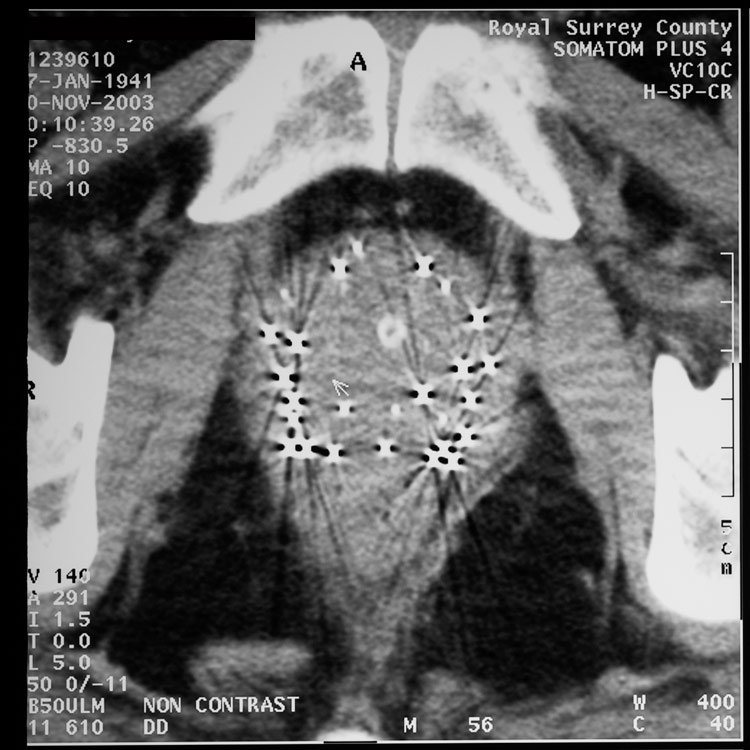
In prostate glands that have been surgically removed, cancer cells are often found to be not just in one place within the gland. Typically there may be three or even as many as seven different places where the cancer cells may be located. These additional sites are often not seen on the MRI scan. To make sure the radiation is targeted and the treatment reaches the cancerous areas, the brachytherapy seeds are implanted throughout the prostate gland to release a field of radiation that matches the shape and size of the prostate gland being treated.
Each seed is a tiny canister made of titanium, the size of a grain of rice (4.5mm long by 0.8mm diameter) which contains a small amount of radioactive material. This radioactive material is iodine125, also sometimes written as I125. Most of the radiation is released from the seeds into the prostate gland over the first 60 days. The seeds continue to be biologically active for about 9 months in total. After that, they are biologically inactive.
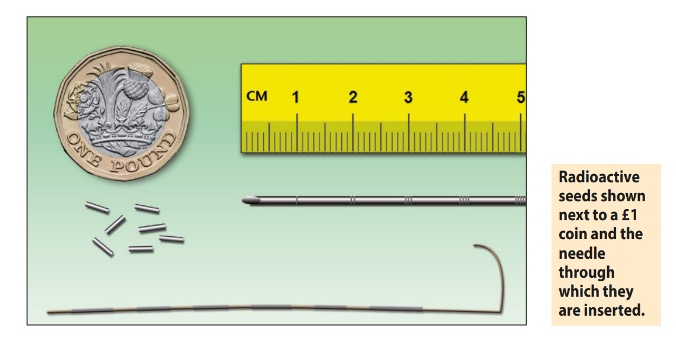
Between 60 and 120 seeds are permanently inserted into the prostate gland. The exact number used will depend on the size of the prostate gland and the location of the cancer cells within it.