
What are the side effects?
Comprehensive Care and Understanding Side Effects: 25 Years of Prostate Brachytherapy
Brachytherapy has been used to treat patients with localised prostate cancer in Guildford for 25 years. The results and outcomes of our patients have been meticulously recorded enabling us to have unparalleled experience in managing and caring for our patients.
After prostate brachytherapy most patients return to normal activities within a few days. The majority of men are back at work within 2-5 days, although the delay may be a little longer if you have a job which involves lifting or a lot of physical activity, for example if you are a fireman, or a builder.
Driving is not usually recommended until 24 hours after anaesthesia and you should check your motor insurance policy to ensure that your policy does not have any specific restrictions that apply to you, after having medical treatment.
Usually, patients experience few problems during the first couple of weeks after brachytherapy treatment. If troublesome symptoms do occur, they tend to be at their worst around 4-6 weeks after the seeds have been implanted as this is when they have released quite a lot of their radiation, and the radiation has begun to work. The symptoms are typically a slow urinary stream, getting up at night to pass urine and some urinary frequency and urgency. Urinary incontinence is rare (<1%) at any stage.
Compared with other forms of radical therapy for localised prostate cancer, such as external beam radiotherapy (EBRT) or surgery (radical prostatectomy), prostate brachytherapy allows patients to quickly return to the same level of daily activities that they had before the procedure. It is as effective as other treatment options at curing prostate cancer but is has a fraction of the side effects with a low incidence of incontinence or impotence problems.
The side effects or complications that may occur can affect your daily life and also that of your partner and family. Here we understand that you need information about the possible side effects and complications to help you chose a treatment that is right for you. We know that there is a lot to take in and we want you to fully understand what is involved and why, so do not be afraid to ask questions. We do not mind repeating what we have said if you did not understand the first time. If you want to, you can bring someone with you or write notes, as this may help you remember what has been said.
Contact us by phone or e-mail if you are at all worried about side effects and want to know more.
Immediately after
Immediately after the seeds have been implanted, you may notice some bruising beneath the scrotum and tenderness between the legs. This is the place where the needles that delivered the seeds were inserted.
Once the catheter has been removed after your CT scan, you may notice some discomfort when passing urine. While in hospital, your urine will be filtered, to ensure that any loose seeds that you may pass are caught. This event is rare and if it does occur it will usually happen within the first 24 hours following implantation of the seeds. We will check that you are able to pass urine satisfactorily before you are discharged home.
A small percentage of patients (about 2 patients in every 100) may hold a significant residual amount of urine in their bladder immediately after the seeds are implanted. If this happens to you will be shown how to insert a temporary, disposable catheter to drain the bladder. In the unlikely event this is necessary normal urination usually occurs with a day to a week.
It is common to see some blood in the urine for a day or two after the procedure. This is normal, so do not be alarmed.
Some patients find that, immediately following the implant, they may become constipated. This can usually be relieved by increasing the amount of fresh fruit, vegetables and fibre in your diet. Also recommended is a daily tablet of Senna.
You should drink approximately 1½ to 2 litres of fluids each day (2 to 3 pints) for the first week to help to flush out your urinary system, although you should limit your fluids after 7.00 at night. This will help to reduce the amount of urine produced during the night and decrease the number of times you will have to get up to go to the toilet.
Two to four weeks after
These side effects are due to the swelling of the prostate following the procedure and irritation of the prostate and bladder lining due to radiation from the seeds. They are usually temporary, and your prostate gland and bladder will settle down again in time to its pre-implant state. We would normally expect this to be within 6-9 months after the seeds were implanted. Only 1 or 2 out of every 100 men (1-2% of patients) will continue to have difficulty for longer than 9 months.
If you have any difficulty passing water at all after your treatment we would like to know. This side effect, called urinary retention, rarely occurs in our patients treated with brachytherapy (~2%).
If it is not possible for you to wait to contact us, then you should contact your GP or go to your local Accident and Emergency Department. A catheter may be inserted to relieve the immediate problem, but we would like you to contact us as soon as possible after this.

If you have any difficulty passing water at all after your treatment we would like to know. This side effect, called urinary retention, rarely occurs in our patients treated with brachytherapy (~2%).
If it is not possible for you to wait to contact us, then you should contact your GP or go to your local Accident and Emergency Department. A catheter may be inserted to relieve the immediate problem, but we would like you to contact us as soon as possible after this.
Other side effects
Bowel problems
The symptoms can often be managed by changing your diet slightly, by reducing the roughage (fruit and fibre intake) or taking a medicine that stops diarrhoea. Many patients have found that Normacol®, a fibre supplement, available without prescription from most chemists, is very effective in regulating bowel function, if required.
Fewer than 1 in 20 men (less than 5% of patients) may develop difficulties with bowel movements. But bowel symptoms may be more common if you have had additional external beam radiotherapy (EBRT) before the brachytherapy procedure.
The use of a spacing gel inserted immediately after the brachytherapy implant before the patient wakes up can also further minimise bowel symptoms. This temporary gel is inserted between the rectum and prostate gland, separating the organs for approximately 6 months. This further minimizes any radiation exposure of the bowel. The gel is then naturally reabsorbed by the body. The option of a spacer gel will be discussed with you by the clinical team.
Urinary incontinence and erectile dysfunction
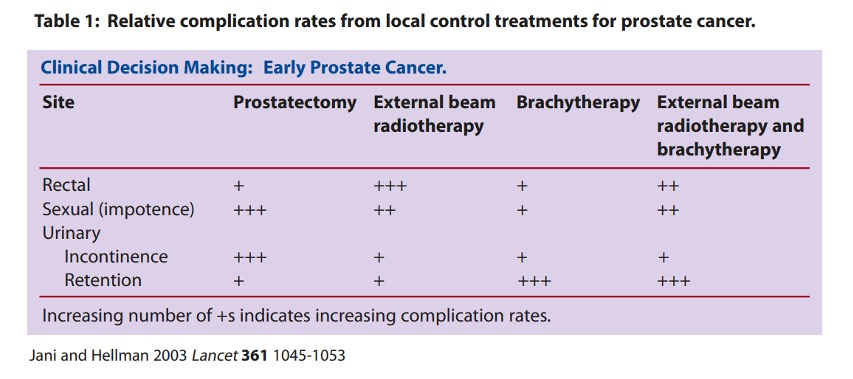
The likelihood of getting these side effects for each treatment has been compared in an article in the Lancet (Jani and Hellman 2003 Lancet 361 1045-1053); a table adapted from this paper is shown below. The more plusses (+) there are the greater is the likelihood of these side effects occurring.
Using our latest brachytherapy technique, less than 2% of patients now experience urinary retention at any stage.
As a world-leading centre in prostate brachytherapy we have an ongoing research programme to continually improve the brachytherapy technique. The results of our most recent improvements have recently been published showing that 85% of the patients we treated had retained sexual potency one year after the seeds were implanted and 83% retained sexual potency after two years. Sexual potency deteriorates naturally as you get older. We found that about 75% of the patients we treated with brachytherapy who were sexually potent one year after therapy were still sexually potent after 5 years. These results are similar to the effects expected from aging.
Patients are encouraged to take tablets such as sildenafil (Viagra) or tadalafil (Cialis) on a weekly basis following brachytherapy to help optimise nighttime and early morning erection. This has been shown to help preserve erectile function in the longer term. Commonly men notice a decreased or dry ejaculate following brachytherapy, although some may retain their fertility.
Hormone therapy may also affect your ability to achieve an erection. We have found that over the long term, potency rates are similar to those treated without hormone therapy. Being proactive in treating men experiencing difficulties with erections causes a quicker resolution of the problem and improves erectile function in the longer term. If you find you have erectile problems, please feel free to discuss this during your follow up consultations.
Your care is delivered by a very experienced multidisciplinary clinical team, providing patient-centred, personalised prostate cancer treatment tailored to your individual needs. We use highly effective proven treatments designed to achieve the best possible long-term cancer outcomes while minimising side effects.